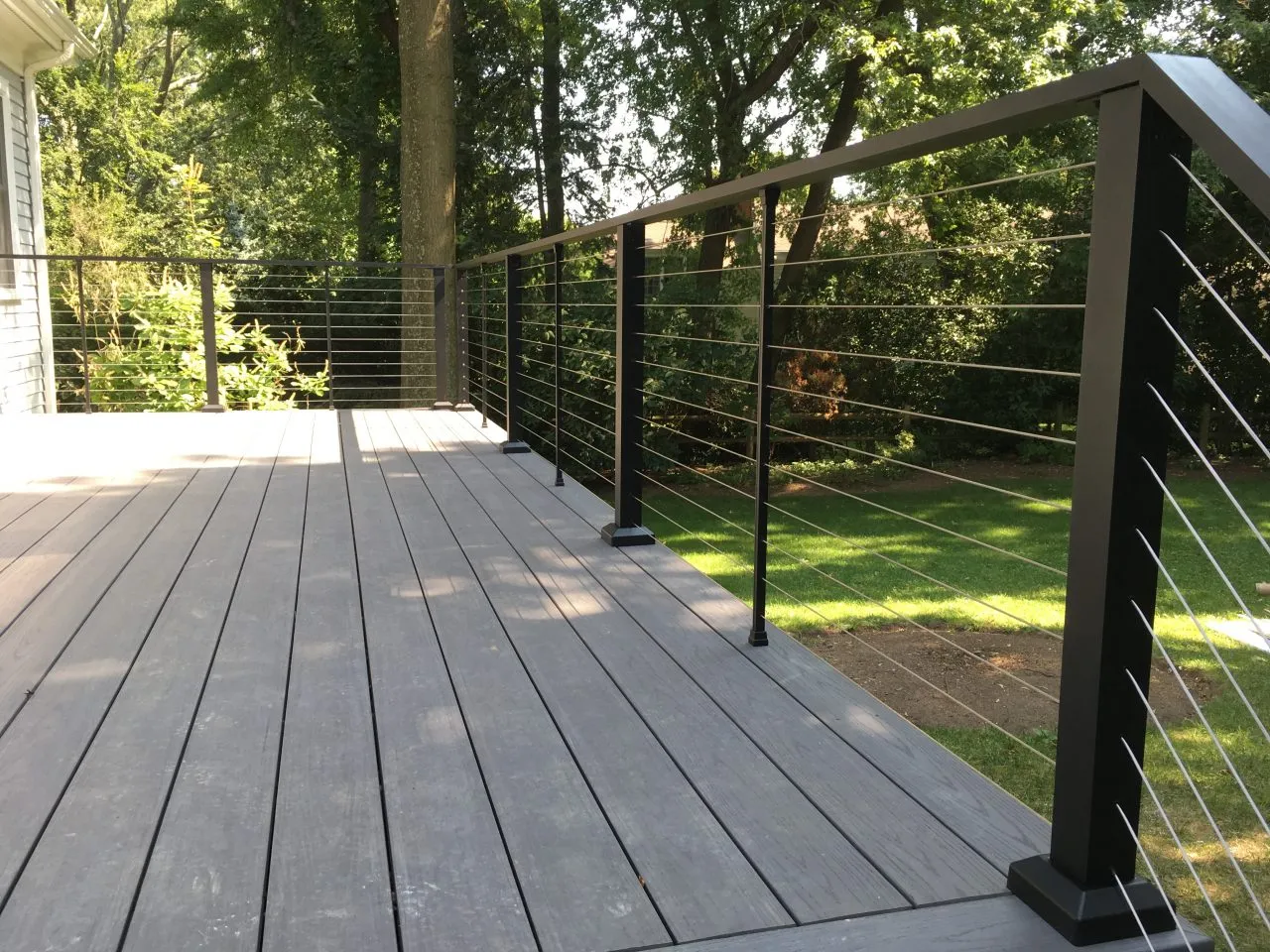
Yes. Sloped yards are the normal case in Pittsburgh. The fence is either racked, where the rails run parallel to the ground, or stepped, where level panels drop one after another like stairs. Which one suits depends on how steep the yard is and what the fence has to keep in.
Racked or stepped: which is better?
- Racked: the rails follow the slope and the pickets stay plumb. The gap under the fence stays even, which is best for dogs. Aluminum, chain link and site-built wood rack well.
- Stepped: each panel is level and the next one sits lower. It handles steep grades and rigid panels such as most vinyl, but it leaves a triangle of open space under every panel.
- Built in place: rails and boards are cut on site to match the ground. It costs more in labor and gives the closest fit on uneven hillsides.
I have a dog that digs and a yard that drops. How do I avoid gaps?
Choose a racked or site-built fence so the bottom stays close to the soil, then harden the base. Options are a pressure-treated kick board, pickets scribed to the grade, or welded wire laid in a shallow trench under the fence. With chain link, a bottom rail or a tension wire stops the mesh being pushed outward.
My yard is steep and rocky and two companies turned the job down. Who does this?
Call us and we will come and look before giving an answer. Steep lots and rock are everyday conditions in Allegheny County. Shale and sandstone are close to the surface on many hillsides. Holes in rock are drilled or broken out, or the post spacing is adjusted to miss a ledge. Material may have to be carried down steps by hand. All of that is slower, so the price is set after a site visit.
Is it safe to put a fence on a slope that might slide?
Sometimes not, and we will say so. Parts of the Pittsburgh area are prone to landslides, especially where weak claystone lies under the soil. Warning signs are fresh cracks in the ground, leaning trees or poles, a bulge at the bottom of the bank and a retaining wall that is tipping. A fence does not hold a slope. If we see those signs, a geotechnical engineer should look before a fence is built. The same goes for dips and cracks that might be mine subsidence.
Do installers dig by hand or with a machine?
Both, and in the city often by hand. A powered auger is quick where it can get in. Hand digging is the rule in row house yards reached through the house or a narrow passage, on steep banks, beside retaining walls and foundations, and close to marked utility lines.
The only real price is one based on your own yard. The estimate is free and done on site. Call (412) 851-6524 or text us a photo of the fence line.